
Trending
Gold Corner
Source: Newsmaker.id
Gold and Oil Fundamental Weekly Summary
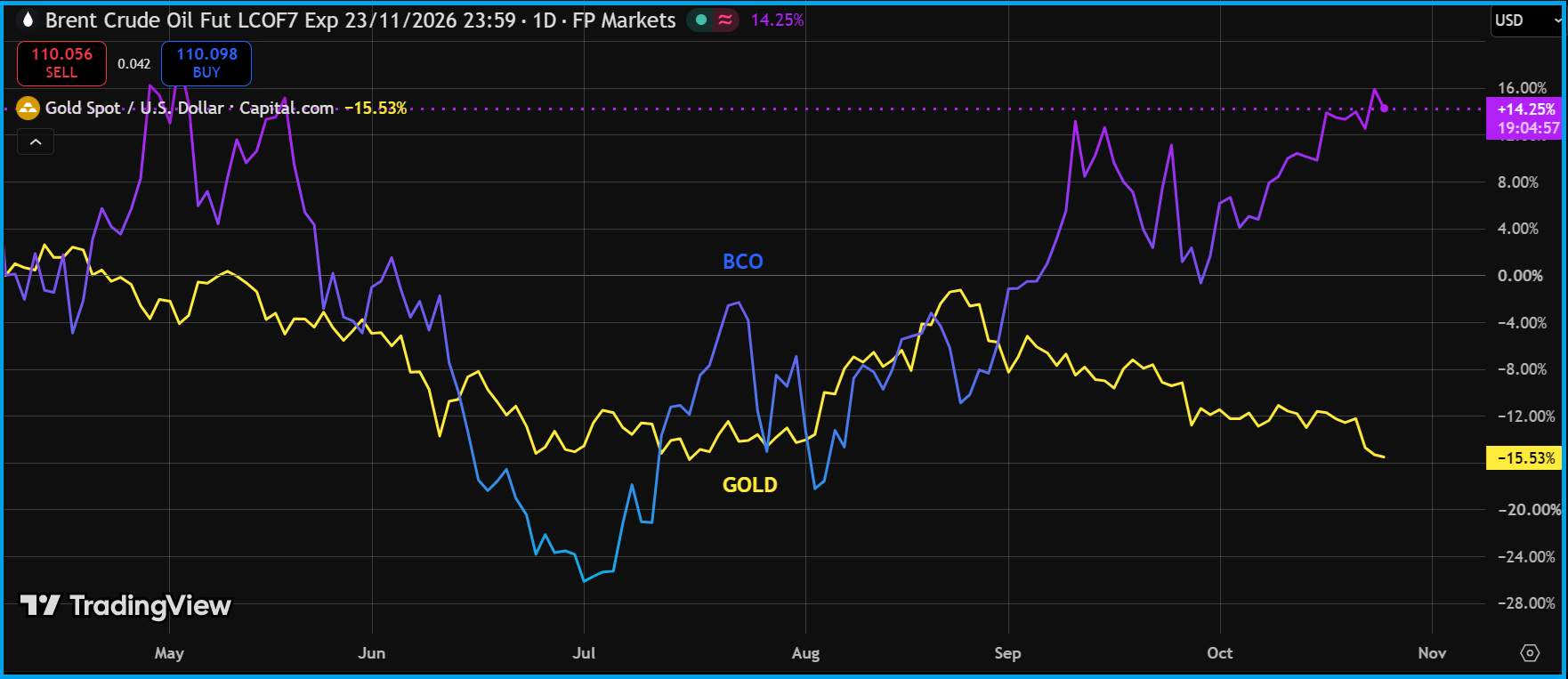
Commodity markets experienced contrasting movements last week, with gold facing mounting bearish pressure while crude oil prices surged amid escalating geopolitical tensions. Gold weakened as the US dollar strengthened, Treasury yields recovered, and rising energy costs fueled inflation concerns. Meanwhile, Brent crude experienced volatile trading before ending the week sharply higher, supported by growing fears of potential disruptions to global energy supplies.
Escalating Houthi attacks on Saudi Arabian infrastructure, threats to shipping routes through the Strait of Hormuz, and reports of an offshore oil spill near the United Arab Emirates strengthened oil prices. In contrast, gold failed to benefit from geopolitical uncertainty as investors remained more concerned about persistent inflation and the Federal Reserve's interest rate outlook. These pressures pushed gold through the psychological $4,000-per-ounce level at one point, bringing prices close to a three-month low.
Looking ahead, investors will closely monitor the Federal Reserve's interest rate decision, monetary policy statement, US GDP figures, and the Personal Consumption Expenditures (PCE) inflation report. These developments could significantly influence the direction of the US dollar, gold, and oil markets. A hawkish Fed stance could extend bearish pressure on gold, while oil prices may remain supported if Middle East tensions escalate further and supply disruption risks persist.
Gold Weekly Outlook: Bearish Pressure Remains Dominant
Gold prices are expected to remain under bearish pressure in the coming week after closing the previous trading week at $3,995 per troy ounce. Based on the daily (D1) chart, gold continues to display a pattern of lower highs and lower lows, suggesting that the broader downtrend remains intact. The failure to sustain gains within the $4,200–$4,400 range has reinforced selling pressure, while the psychological $4,000 level has emerged as a critical area that could determine the market's next direction.
From a technical perspective, failure to reclaim and hold above $4,000 could expose gold to further downside pressure, with immediate support located around $3,950–$3,900. A sustained breakdown below this zone could extend losses toward $3,800. Conversely, a recovery above $4,100 could encourage a technical rebound toward resistance levels at $4,200–$4,300. Nevertheless, as long as prices remain below these key resistance areas, upward movements may be viewed as temporary corrections within the prevailing bearish trend rather than confirmation of a sustained bullish reversal.
On the fundamental side, market attention will focus on the Federal Reserve's interest rate decision, monetary policy guidance, and upcoming US GDP and PCE inflation data. A continued hawkish stance from the Fed could strengthen the US dollar and maintain downward pressure on gold, particularly as elevated oil prices raise concerns about persistent inflation. Overall, gold's outlook for the coming week remains bearish, with potentially heightened volatility surrounding major economic releases. Although a technical rebound remains possible, stronger buying momentum and a confirmed breakout above key resistance levels would be needed to signal a more sustainable recovery.
Brent Crude Weekly Outlook: Bullish Momentum Remains Intact
Brent crude oil (BCO) is expected to maintain a cautiously bullish outlook in the coming week after the chart's previous weekly closing level of $111.63 per barrel. Based on the daily (D1) chart, Brent continues to form a series of higher highs and higher lows, indicating that the broader uptrend remains intact. The recovery from early October and the move above $110 reflect sustained buying interest, although profit-taking and short-term corrections could emerge following the recent rally.
From a technical perspective, the $110–$108 range represents an important support zone for maintaining bullish momentum. As long as prices hold above this area, Brent could retest resistance around $113–$115 per barrel. A sustained breakout above $115 may open the door for further gains toward $118–$120. Conversely, a breakdown below $108 could trigger a deeper correction toward $105 and potentially $100. Nevertheless, as long as the broader bullish structure remains intact, short-term pullbacks may represent temporary corrections rather than a confirmed trend reversal.
Fundamentally, escalating tensions in the Middle East continue to support oil prices by raising concerns over potential supply disruptions. Attacks targeting Saudi Arabian infrastructure and uncertainty surrounding regional shipping routes have reinforced the geopolitical risk premium. However, diplomatic developments could ease some of these concerns and encourage profit-taking. Reuters reported that Brent's benchmark futures closed at $116.72 on October 23, although the supplied chart shows a different closing level, which may reflect differences in contracts or pricing sources.Overall, Brent's weekly outlook remains cautiously bullish, with elevated volatility likely as traders assess geopolitical risks, global demand expectations, and potential supply disruptions.
DISCLAIMER
Please note: This article is intended for analytical and
informational purposes only and should not be considered definitive investment
advice. Investors are advised to carefully assess fundamental and technical
market developments before making any trading or investment decisions.