
Trending
Analysis & Opinion
Source: Newsmaker.id
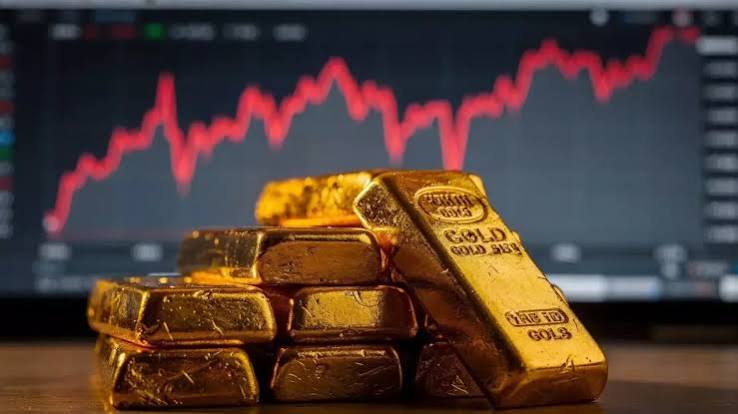
The decline in global gold prices on Friday (October 23, 2026) has drawn significant attention from market participants, as the precious metal breached the psychological level of US$3,886 per troy ounce. At the time of writing, spot gold (XAU/USD) had fallen to around US$3,986, extending a sharp decline seen throughout the week. This drop is more than just a typical price correction; breaking below the US$4,000 mark signals intensifying selling pressure and tests investor confidence in gold’s ability to rebound in the near term. This raises a major question: why does gold continue to weaken even as global geopolitical tensions escalate?
A primary driver of the pressure on gold is the surge in global oil prices. The conflict in the Middle East—specifically attacks on energy facilities in Saudi Arabia—has pushed Brent crude prices toward US$113 per barrel. Rising oil prices heighten inflation risks, as higher energy costs can drive up the prices of goods and services. For the United States, this presents a serious challenge; if inflation proves difficult to contain, the Federal Reserve (the Fed) may be forced to keep interest rates higher for longer. Consequently, gold—which yields no interest—becomes less attractive compared to interest-bearing investment instruments.
However, there is an intriguing aspect to this particular decline. In recent sessions, gold has weakened even as the US dollar and US government bond yields have fallen—conditions that would typically provide support for gold prices. This suggests that the relationship between gold and the US dollar does not always move in opposite directions. In our view, the market is currently driven more by concerns regarding US monetary policy and a potential move by investors to trim their positions in order to secure liquidity. As selling pressure intensifies, a breach of a key level—such as US$4,000—could trigger the closing of long positions and accelerate a price decline.
Nevertheless, a drop in the price of gold does not necessarily signal the end of its long-term outlook. Persistent geopolitical tensions, the need for central banks to diversify their foreign exchange reserves, and ongoing global economic uncertainty remain compelling reasons for investors to hold gold as a hedge. The core issue is that the market is currently weighing whether the risks posed by inflation and high interest rates outweigh the protective benefits gold offers. In such an environment, prices might see a temporary recovery, but any such rebound would not be sufficient to confirm that the selling pressure has fully subsided. Investors should monitor whether buying demand strengthens and whether the price can hold above the psychological level that was previously breached.
Looking ahead, market attention will be focused on the Federal Reserve meeting scheduled for October 27–28, as well as developments regarding U.S. inflation. If the Fed signals that further interest rate hikes are necessary, gold could face continued downward pressure. Conversely, if expectations for monetary tightening begin to wane, the potential for a price recovery could re-emerge. According to Newsmaker, the US$4,000 level now serves as a critical threshold for gauging shifts in market sentiment, while the US$3,960–US$3,940 range warrants close attention should the decline persist. The current downturn does not mean that the potential for gains has vanished; rather, it serves as a reminder that the price of gold is driven not only by war and uncertainty but also by the trajectory of inflation, interest rates, and how investors choose to navigate risk.