
Trending
Gold Corner
Source: Newsmaker.id
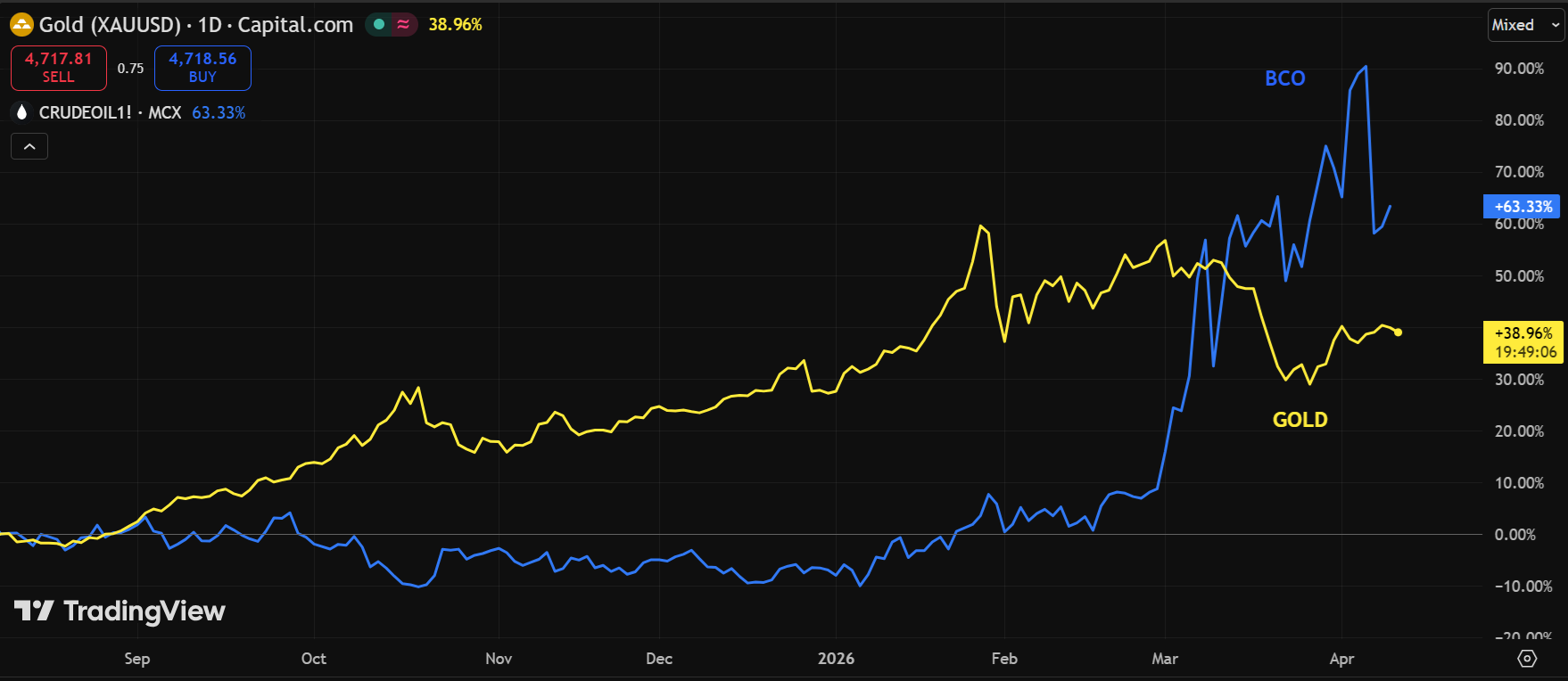
The movements of gold and crude oil over the past week were both heavily influenced by developments in the U.S.–Iran conflict, particularly regarding the Strait of Hormuz, a vital route for global energy distribution. For gold, price movements tended to be volatile as the market continued to weigh two major opposing forces: on one hand, geopolitical tensions boosted demand for safe-haven assets; on the other hand, surging energy prices risked driving inflation higher and limiting the room for central banks—especially the Fed—to ease monetary policy. These conditions put pressure on gold early in the period, as the market anticipated that a prolonged conflict could keep oil prices high and maintain upward pressure on interest rates.
As market attention intensifies regarding the Hormuz Strait deadline, gold is moving in both directions. Uncertainty over the likelihood of a deal being reached is causing market participants to remain cautious. If disruptions in the Strait of Hormuz persist, energy inflation could rise and keep yields high, which typically acts as a headwind for gold. At the same time, unresolved geopolitical threats continue to support demand for safe-haven assets. As a result, gold is not establishing a clear direction but is instead fluctuating in response to shifts in market sentiment.
Market sentiment then shifted when news of a temporary ceasefire emerged. Risk-on sentiment immediately strengthened globally, the U.S. dollar weakened, and yields tended to decline. This combination acted as a positive factor for gold, as it reduced the opportunity cost of holding this non-yielding asset. During this phase, gold prices rose quite sharply and briefly touched the high around US$4,850 per ounce. However, the rally was not entirely stable, as geopolitical risks had not completely dissipated.
After that, the market faced new friction regarding the implementation of the ceasefire. Differing interpretations emerged regarding the reopening of the Strait of Hormuz, the issue of tolls, and escalations on other fronts such as Lebanon. This situation made gold highly sensitive to every headline once again. When signs emerged that the ceasefire was fragile or at risk of breaking down, safe-haven demand surged and gold prices rose. However, when the dollar and yields rebounded, gold’s gains were quickly eroded. That is why gold’s price action during this phase appeared volatile on an intraday basis and was characterized by frequent reversals.
Ahead of further U.S.–Iran talks, gold has generally held steady at higher levels on a weekly basis, despite experiencing an intraday correction due to profit-taking. Stronger-than-expected U.S. inflation data, driven primarily by a surge in energy costs, has prompted the market to reassess the direction of the Fed’s interest rates. Typically, high inflation can act as a headwind for gold by reinforcing the case for higher interest rates to persist longer. However, in this context, the weakening dollar and geopolitical uncertainty remain strong enough to keep gold relatively firm. As a result, gold remains on track for a weekly gain despite continued high volatility.
Meanwhile, crude oil prices fluctuated more sharply as the market reacted immediately to threats and opportunities regarding changes in global supply. At the start of the period, oil prices remained overshadowed by significant concerns over supply disruptions stemming from U.S.–Iran tensions and pressure in the Strait of Hormuz. Brent and WTI held at very high levels, with WTI even recording its highest closing price in several years. The market’s primary fear was that a prolonged conflict could disrupt global oil flows on a massive scale, though concerns about an economic slowdown temporarily limited further gains.
Tensions reached a peak when reports indicated that physical oil prices had surged sharply due to disruptions affecting millions of barrels of daily supply through the Strait of Hormuz. Attacks on Saudi petrochemical facilities also widened risk premiums, leading the market to view the supply threat not merely as theoretical, but as very real. In situations like this, oil prices typically rise not solely due to actual shortages, but also because the market begins to factor in potential short-term risks and the costs of distribution disruptions into the price.
However, a major shift occurred when a temporary ceasefire was announced. Hopes that oil supplies from the Strait of Hormuz could resume triggered a sharp correction in oil prices. Brent and WTI plunged sharply in a single session, recording one of the steepest daily declines during the conflict. This reaction indicates that the market had previously priced in a very high risk premium; consequently, when the prospect of de-escalation emerged, prices immediately shed most of the gains driven by supply fears.
Even so, this correction did not immediately dispel all concerns. The market then assessed that supply risks had not truly disappeared. The ceasefire was considered fragile, tanker traffic through the Strait of Hormuz had not yet returned to normal, and production disruptions in Saudi Arabia remained a factor constraining supply. Consequently, oil prices rebounded after the sharp decline, driven by the view that the process of supply normalization would take time and remained vulnerable to disruption by new geopolitical developments.
Ahead of the next U.S.–Iran talks, oil prices edged lower again but remained at historically high levels. On a weekly basis, both Brent and WTI posted significant declines, reflecting how the market has shifted from a phase of panic pricing to a phase of repricing following the emergence of opportunities for de-escalation. Although down sharply from their peaks, oil prices still indicate that regional risks have not entirely disappeared and that the market continues to price in the possibility of further supply disruptions.
Overall, this series of price movements reveals an interesting pattern: gold’s price movements are more complex, influenced by a combination of safe-haven demand, the dollar, and interest rate expectations, while oil’s price movements are more directly tied to shifts in perceptions of supply risks. When the market fears that the Strait of Hormuz will be seriously disrupted, oil surges and gold tends to be held back by concerns over inflation and high interest rates. Conversely, when the prospect of a ceasefire emerges, oil falls sharply as the risk premium diminishes, while gold actually gains support from a weaker dollar and falling yields. In other words, both reflect geopolitical tensions, but through different market transmission channels.
This week's predictions.
Gold is currently still in a sensitive phase, as the market is weighing two key factors: geopolitical tensions and the direction of U.S. interest rates. From a technical perspective, the price around 4,701 indicates that gold is attempting to stabilize after a sharp decline, but it is not yet strong enough to form a new uptrend. The 4,600 level remains an important support, while 4,800 is the nearest resistance level to watch.
From a fundamental perspective, the U.S.–Iran conflict and uncertainty in the Strait of Hormuz continue to sustain safe-haven demand for gold. However, at the same time, rising oil prices are also increasing inflation risks, which could lead the Fed to keep interest rates high for longer. These conditions are causing gold prices to fluctuate, as safe-haven sentiment supports prices, but pressure from yields and monetary policy is holding back any significant rise.
For the coming week, gold is likely to remain volatile within the 4,600–4,800 range. If geopolitical tensions escalate again, gold could strengthen and test the 4,800 to 5,000 range. Conversely, if the market focuses more on inflation and the Fed’s hawkish stance, gold could come under pressure again toward the 4,600 or even 4,400 range. Thus, gold’s direction this week will still be heavily influenced by fundamental developments, while technically the market remains in a consolidation phase.
Oil (BCO) is currently at the 101 level and still shows a fairly strong structure following a sharp surge caused by supply disruptions and tensions in the Strait of Hormuz. From a technical perspective, the primary trend remains bullish, but it has now entered a consolidation phase following the major rally. The 100–98 area serves as a key support level holding the price, while resistance is in the 103–105 range. As long as prices remain above 100, the bias for oil is likely to stay bullish, although its movement is starting to become more choppy.
From a fundamental perspective, oil prices remain strongly supported by global supply risks. Tensions between the U.S. and Iran, disruptions to shipping in the Strait of Hormuz, and the fact that tanker traffic has not yet returned to normal are causing the market to continue factoring a risk premium into prices. However, unlike the initial phase of very aggressive gains, the market is now beginning to weigh the possibility of de-escalation or a ceasefire. This is why prices are no longer soaring but are instead tending to stabilize at elevated levels while awaiting clarity on the geopolitical direction.
For the coming week, the oil outlook remains relatively bullish as long as there is no significant news of peace. If tensions rise again, prices could potentially rise back above 103–105 and even reach higher levels. Conversely, if negotiations go well and supply begins to recover, prices could correct downward below 100 toward the 98 or 95 range. So currently, oil is in a “high-level consolidation” phase, where the next direction will be heavily determined by the development of the conflict and global supply conditions.
DISCLAIMER
Note: This article is for analytical purposes only and is not intended as a definitive reference. Please consider fundamental and technical developments in the market before making any investment decisions.