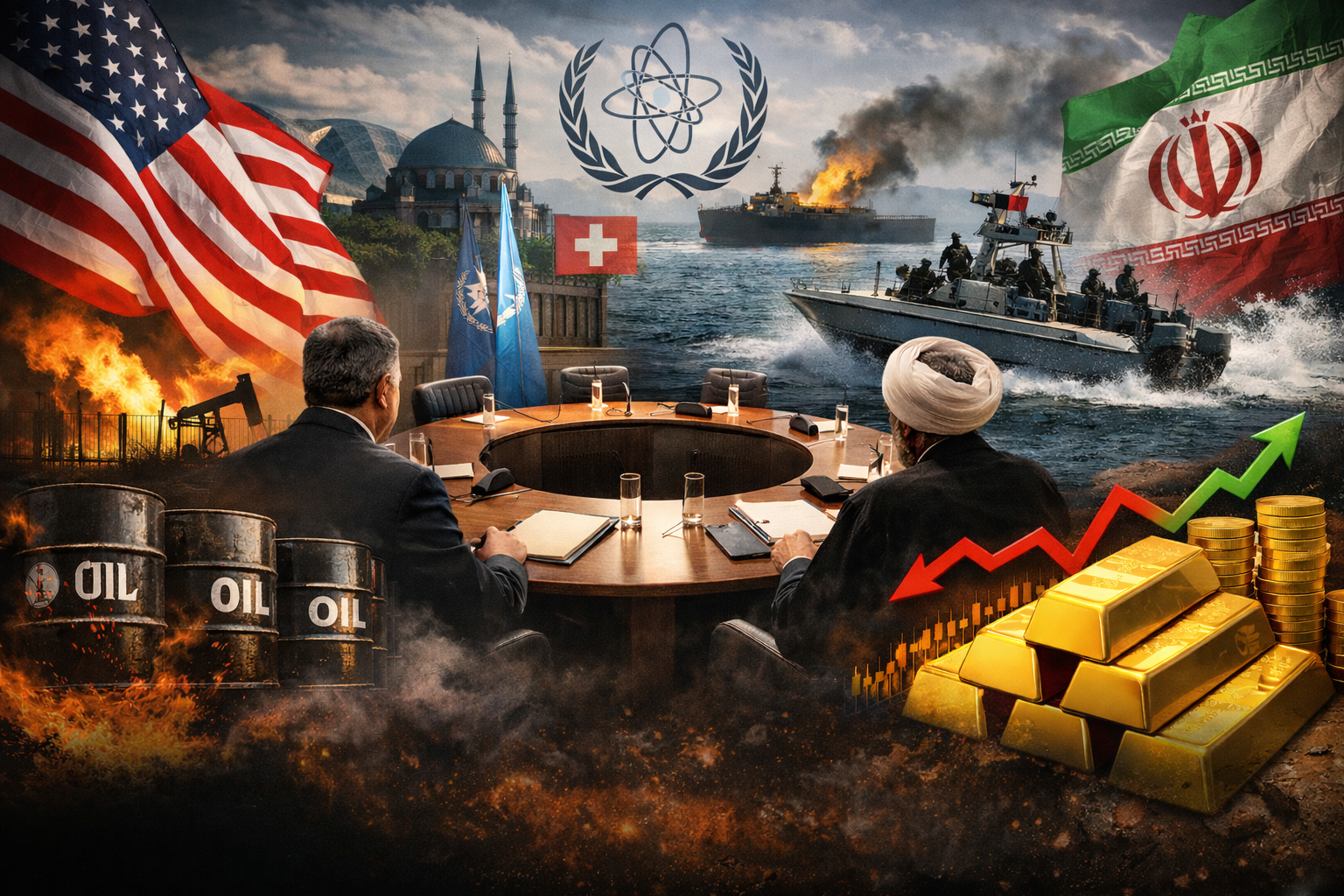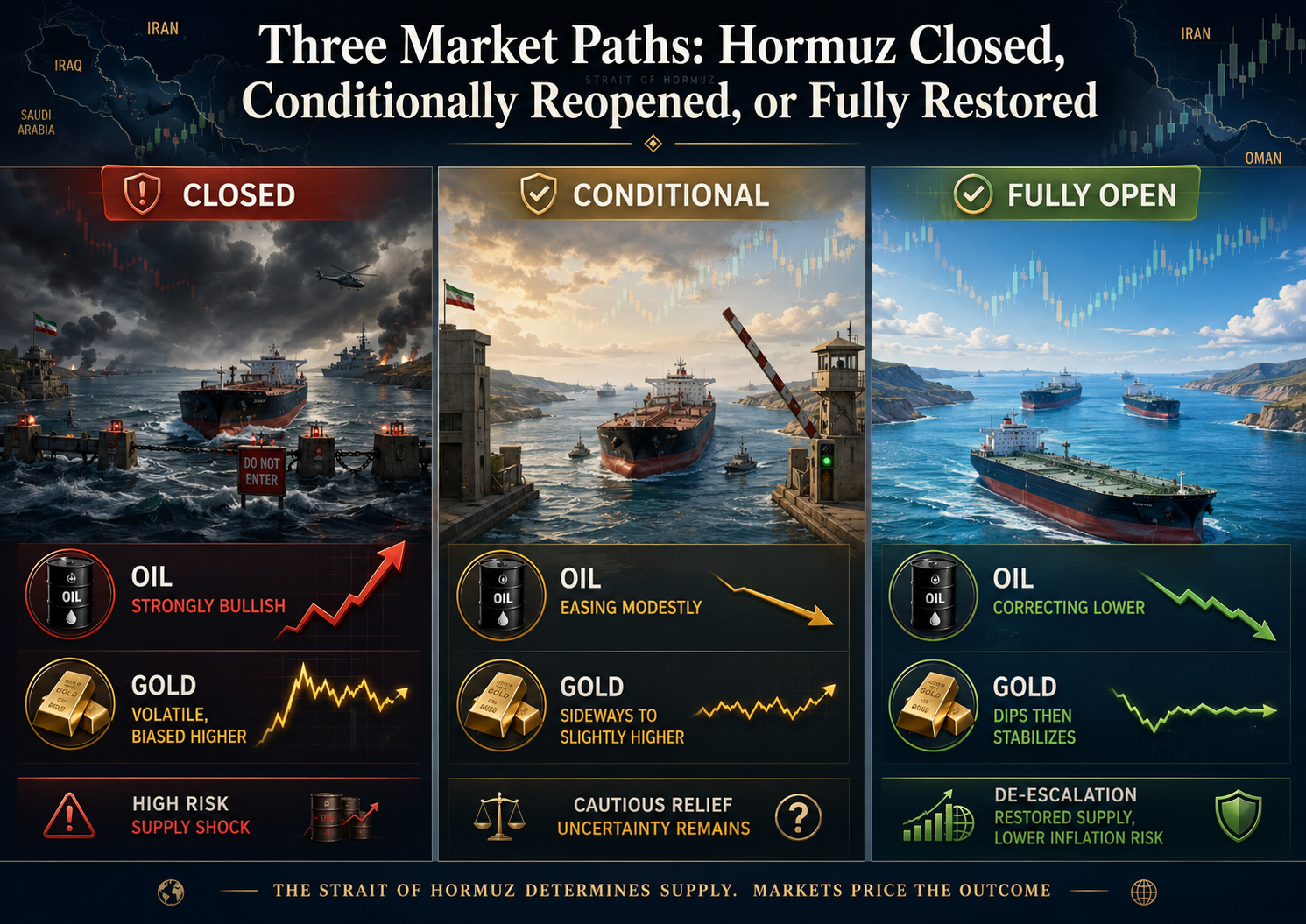
Three Market Paths: Hormuz Closed, Conditionally Reopened, or Fully Restored
1. If no agreement is reached and Hormuz remains closed
For oil, this would be the most bullish scenario. The market would immediately reprice supply risks, shipping costs, insurance premiums, and tanker availability. Reuters has also noted that official tanker flows through the Strait of Hormuz remain very limited, although there are signs that “dark” shipments are still taking place. This means the market is still struggling to assess the real supply situation.
For gold, the initial reaction would likely be positive as investors seek safe-haven assets. However, the situation is not that simple. If oil prices continue to rise, inflation risks may also increase, pushing expectations for higher interest rates. This kind of environment has previously pressured gold, especially when the U.S. dollar and Treasury yields strengthened. As a result, gold may rise at first, but could remain vulnerable to a pullback if the market shifts its focus back to inflation and the Federal Reserve.
Scenario 1 conclusion: Oil has a clearer upside bias. Gold may also rise, but its move is unlikely to be as clean as oil’s. Key levels to watch for gold are US$4,425 as support and US$4,560–4,600 as psychological resistance.
2. If an agreement is reached, but Hormuz is reopened conditionally
This is a “calmer, but not yet safe” scenario. Oil prices may decline as the risk premium eases, but the downside may be limited because a conditional reopening still leaves several risks on the table. Shipments may not immediately return to normal, insurance costs may remain elevated, and market participants will likely wait for clear evidence that supply flows have truly stabilized.
Reuters also reported that oil prices declined after signs of an Israel–Lebanon ceasefire raised hopes for a broader resolution. However, upward pressure could remain if restrictions on oil flows continue.
For gold, this scenario could provide some support because lower oil prices may ease inflation concerns. However, as geopolitical tensions also cool, safe-haven demand may weaken at the same time. Therefore, gold is more likely to trade sideways or rise only modestly, rather than stage a strong rally.
Scenario 2 conclusion: Oil may decline toward the lower US$90s area, while gold could remain above US$4,440 as long as the U.S. dollar and Treasury yields do not strengthen sharply.
3. If a full agreement is reached and Hormuz is completely reopened
This would be the most bearish scenario for oil. If the Strait of Hormuz is fully reopened, a significant portion of the war-related risk premium could disappear. Brent crude could fall toward US$82–88, or even lower if shipping activity, inventories, and Middle East supply recover quickly.
Still, caution is needed, as Reuters has noted that the normalization of supply may still be disrupted by logistics risks, tanker availability, and changing shipping patterns.
For gold, the initial reaction could be negative as safe-haven demand weakens. However, gold may later stabilize if falling oil prices reduce inflation pressures, pull yields lower, and weaken the U.S. dollar. In this case, gold may decline first before finding a new base around US$4,380–4,425.
Scenario 3 conclusion: Oil faces the highest risk of a sharp correction. Gold may also decline initially, but it does not necessarily have to crash, as easing inflation and lower yields could provide support afterward.
Key levels to watch
For Gold / XAUUSD, important support levels are US$4,425, followed by US$4,380. Resistance levels are seen at US$4,500, US$4,560, and US$4,600.
For Brent Oil, the key area to watch is US$95–97 as the current zone, US$100–105 if the crisis escalates, and US$88–90 if a stronger agreement begins to take shape.
In conclusion, if Hormuz remains closed, oil is likely to stay bullish, while gold may also rise but remains vulnerable to pressure from a stronger U.S. dollar and higher yields. If Hormuz begins to reopen, oil may fall first, while gold could rise only modestly and continue to wait for signals from the dollar and the Federal Reserve. If Hormuz is fully reopened, oil would be the most vulnerable to a sharp decline, while gold could face a short-term correction before gaining stronger support from lower global inflation risks, which may give the Fed more room to consider cutting interest rates.(mrv)
Source : Newsmaker.id