
Trending
Market Academy
Source: Newsmaker.id
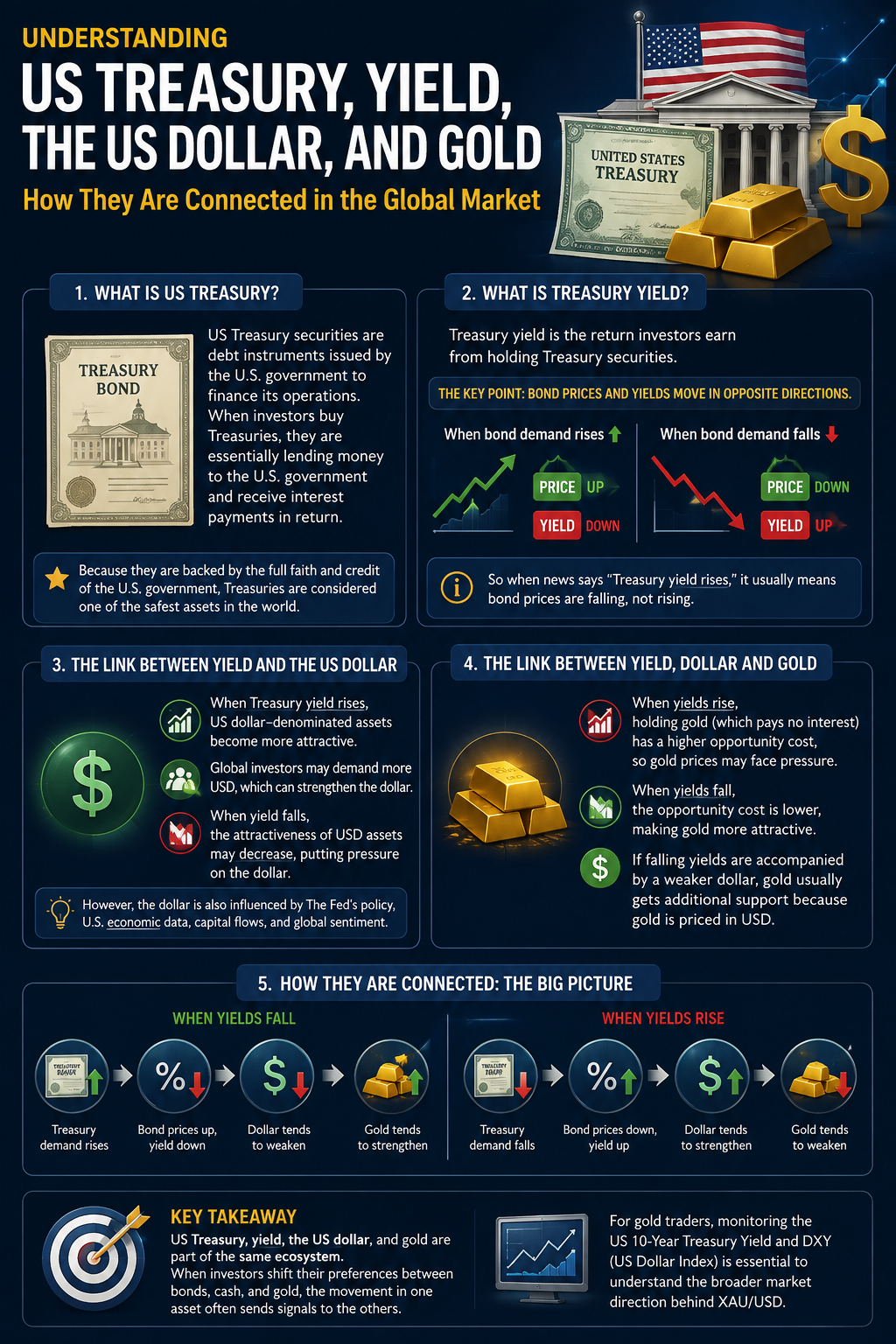
For traders and investors, the terms US Treasury, Treasury yield, the US dollar, and gold often appear together. These four assets are closely connected, and movements in one can influence sentiment across global financial markets. To understand the relationship, it is useful to start with US Treasuries. Simply put, US Treasuries are debt securities issued by the United States government to raise funds. When investors buy Treasuries, they are essentially lending money to the US government. In return, investors receive interest payments based on the terms of the security.
So, what is Treasury yield? Yield represents the return an investor receives from holding a bond. One of the most important concepts to understand is that bond prices and yields move in opposite directions. When demand for Treasuries increases, bond prices rise and yields fall. Conversely, when investors sell Treasuries, bond prices decline and yields rise. Therefore, when the market says that “Treasury yields are rising,” it generally means that Treasury prices are falling.
Treasury yields are also closely linked to the US dollar. When Treasury yields rise, dollar-denominated assets may become more attractive because they offer higher potential returns. This can increase demand for the US dollar and support its value. On the other hand, when yields fall, the attractiveness of dollar-denominated assets may decline, potentially putting pressure on the dollar. However, this relationship is not absolute because the US dollar is also influenced by Federal Reserve policy, economic data, global capital flows, and overall market sentiment.
The relationship with gold is equally important. Unlike Treasuries, gold does not pay interest or a coupon. Therefore, when Treasury yields rise, the opportunity cost of holding gold increases because investors have the option of holding an interest-bearing asset instead. This can put downward pressure on gold prices. Conversely, when yields fall, the opportunity cost of holding gold decreases, potentially making the precious metal more attractive. If falling yields are also accompanied by a weaker US dollar, gold can receive additional support because gold is priced in US dollars.
The relationship can be simplified as follows: higher demand for Treasuries → bond prices rise → yields fall → the US dollar may weaken → gold may strengthen. Conversely, lower demand for Treasuries → bond prices fall → yields rise → the US dollar may strengthen → gold may come under pressure. However, this pattern does not always occur perfectly because gold is also influenced by inflation, geopolitical risks, central-bank purchases, global economic conditions, and safe-haven demand.
For gold traders, understanding Treasuries and yields is therefore more than just theory. When analyzing XAU/USD, movements in the US 10-Year Treasury Yield and the DXY US Dollar Index can provide important clues about broader market sentiment. If Treasury yields and the dollar are both strengthening, gold typically faces greater pressure. Conversely, if yields and the dollar are weakening, the environment can become more supportive for gold. Understanding this relationship allows traders to look beyond the gold price chart and identify the fundamental forces driving the global market.(mrv)
Source : Newsmaker.id