European Leaders Hold Crisis Security Talks as US Signals Transatlantic Reset
European leaders held a crisis security meeting Monday in Paris after a blizzard of diplomatic interventions by Washington in recent days that have raised doubts over the U.S. commitment to the transatlantic alliance, the bedrock of European security.
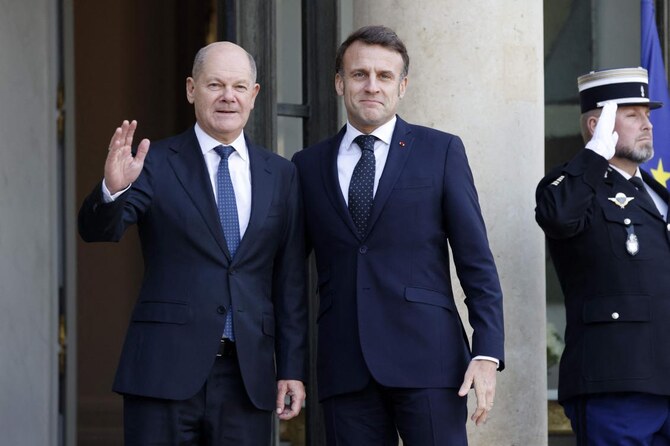
British Prime Minister Keir Starmer, German Chancellor Olaf Scholz, NATO Secretary-General Mark Rutte, European Commission President Ursula von der Leyen and other European leaders were among those attending the emergency summit at the Elysee Palace.
Starmer spoke to reporters after the meeting.
“At stake is not just the future of Ukraine. It is an existential question for Europe as a whole and therefore vital for Britain's national interest,” he said.
“It's clear the U.S. is not going to leave NATO. But we Europeans will have to do more. The issue of burden-sharing is not new, but it is now pressing. And Europeans will have to step up, both in terms of spending and the capabilities that we provide."
“Europe must play its role, and I'm prepared to consider committing British forces on the ground alongside others, if there is a lasting peace agreement. ... But there must be a U.S. backstop, because a U.S. security guarantee is the only way to effectively deter Russia from attacking Ukraine again,” Starmer told reporters in Paris.
Scholz, who faces elections at the end of this week, echoed calls for Europe and Ukraine to be part of the peace talks.
“It is now very clear to us that we must continue to support Ukraine. And it must and can rely on us that this will be the case. We welcome the fact that there are talks on peace development, but it must be and is clear to us — this does not mean that there can be a dictated peace and that Ukraine must accept what is presented to it,” Scholz said.
Ukraine aid
A series of policy shifts by Washington over the past week have transformed Europe’s geopolitical calculations.
U.S. Defense Secretary Pete Hegseth told NATO allies last week that Europe must provide the overwhelming share of aid for Ukraine as it fights Russian invaders.
“Now is the time to invest, because you can't make an assumption that America's presence will last forever,” Hegseth said in a Friday speech in Warsaw.
“The reality that returning to 2014 borders as part of a negotiated settlement is unlikely. The reality of U.S. troops in Ukraine is unlikely. The reality of Ukraine membership in NATO as a part of a negotiated settlement, unlikely,” Hegseth said.
Earlier in the week, U.S. President Donald Trump held a 45-minute phone call with his Russian counterpart, Vladimir Putin, effectively ending Moscow’s isolation since his February 2022 full-scale invasion of Ukraine. Both leaders agreed to begin Ukraine peace talks in Riyadh beginning Tuesday — with Kyiv and Europe excluded from the table.
“That may grate a little bit. But I'm telling you something that's really quite honest … when you looked at Minsk II [peace agreements], there was a lot of people at the table that really had no ability to execute some type of peace process, and it failed miserably. So, we're not going to go down that path,” Keith Kellogg, the U.S. special envoy for Ukraine and Russia, told delegates Saturday at the Munich Security Conference.
That approach is unsustainable, said analyst Armida van Rij, who leads the Europe program at London’s Chatham House.
“Given the U.S. has taken itself out of the equation when it comes to … providing security guarantees for Ukraine or monitoring any kind of potential ceasefire that may happen, it’s really up to the Europeans to implement any kind of ceasefire or peace deal. So, you need the Europeans at the table to be able to discuss that, because otherwise, why would they sign up to something that's been discussed over their heads that commits their troops in a potential risk of direct conflict with Russia?” van Rij told VOA.
Source : VOA