Understanding Tariffs: How They Work and Their Impact on the U.S. Economy, the Dollar, and Gold
Tariffs have once again become a major focus for financial markets as U.S. President Donald Trump increasingly uses them in trade relations with other countries. The United States has introduced different forms of tariffs, including country-specific tariffs, reciprocal tariffs, and import duties targeting particular industries. The U.S. government generally argues that these policies are intended to protect domestic industries, American workers, national security, and the country’s broader economic interests.
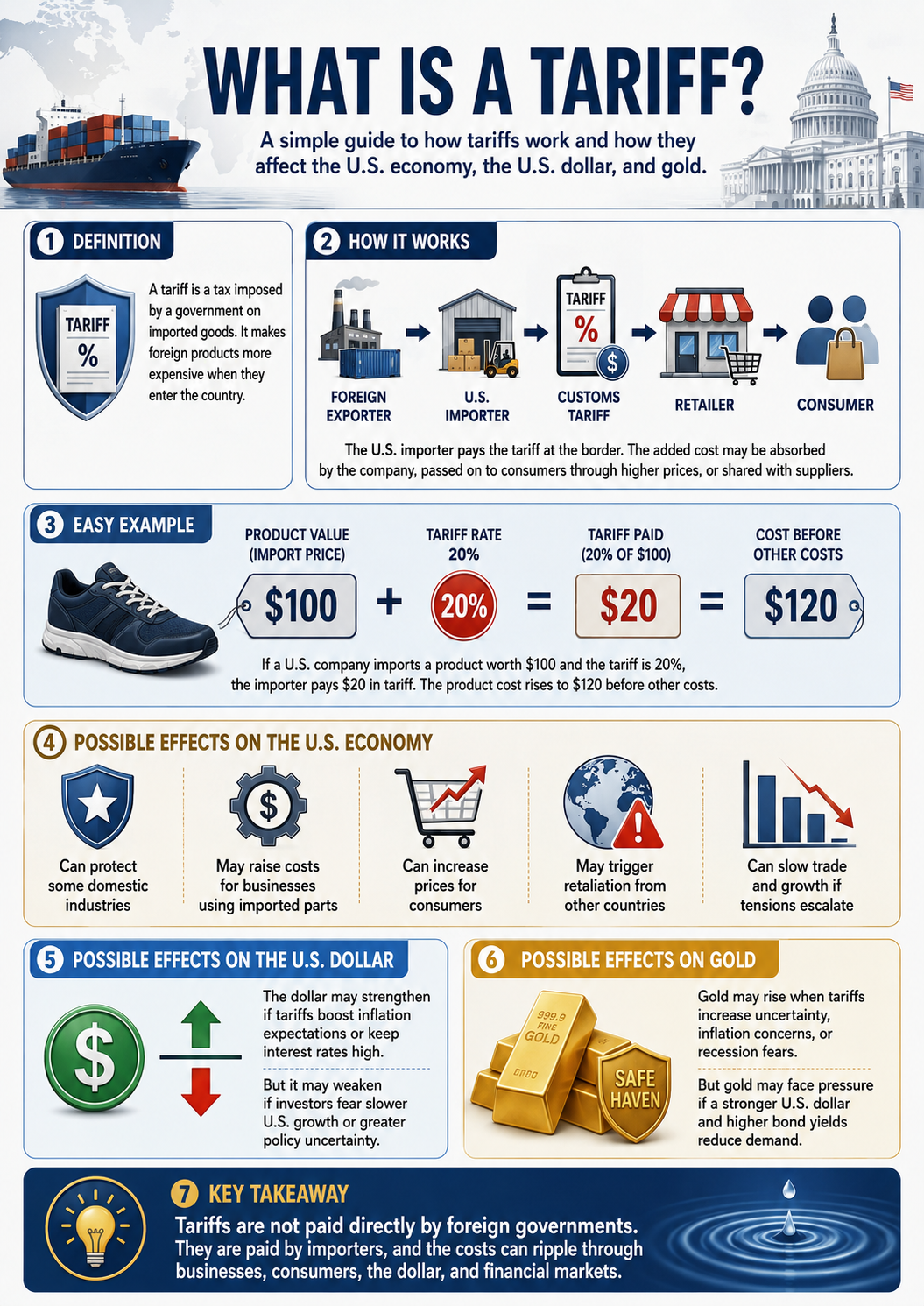
A tariff is essentially a tax imposed by a government on goods imported from another country. Its main effect is to make foreign products more expensive when they enter the domestic market. Although tariffs are often described as taxes imposed “on another country,” the foreign government does not usually pay the tariff directly. In practice, the tariff is initially paid by the company or individual importing the goods into the United States.
The tariff process begins when the U.S. government determines which products, industries, or countries will be affected and sets the applicable tariff rate. Imported products are classified using codes under the Harmonized Tariff Schedule. These codes help customs authorities determine the correct import duty for each product.
When imported goods arrive at a U.S. port or border checkpoint, the importer must declare the value of the goods, their product classification, and their country of origin to U.S. Customs and Border Protection. The importer must then pay the required customs duty before the goods can be released and distributed within the United States.
The most common type of tariff is an *ad valorem* tariff, which is calculated as a percentage of the value of the imported product. However, tariffs can also be calculated based on the quantity, weight, or volume of the goods. Some products may also face a combination of percentage-based and quantity-based duties.
For example, suppose a U.S. company imports a pair of shoes worth US$100. If the U.S. government imposes a 20% tariff, the importer must pay an additional US$20 in customs duty. As a result, the initial cost of the shoes rises from US$100 to US$120 before shipping, storage, marketing, retail margins, and other expenses are included.
The importing company then has several options. It may absorb the tariff and accept a lower profit margin, pass the additional cost on to consumers through higher prices, ask the foreign supplier to reduce its selling price, or share the cost with suppliers and customers. The company may also seek alternative suppliers from countries facing lower tariffs or move part of its production to the United States.
This means that although the importer officially pays the tariff, the economic burden can eventually be shared among businesses, foreign suppliers, workers, retailers, and consumers. In many cases, consumers may indirectly pay part of the tariff through higher retail prices.
Governments use tariffs for several reasons. Tariffs can protect domestic industries by making imported goods more expensive than locally produced alternatives. This can improve the competitiveness of domestic manufacturers, encourage investment in local production, support employment, and generate additional revenue for the government.
Tariffs can also be used as a negotiating tool. A government may threaten or impose tariffs to pressure another country to lower trade barriers, change its economic policies, protect intellectual property rights, or provide better access to its domestic market.
However, tariffs do not automatically produce positive results. Many American companies depend on imported raw materials, machinery, electronic components, metals, chemicals, and vehicle parts. When these imported inputs become more expensive, production costs for U.S. companies may also rise.
Businesses facing higher production costs may increase prices, reduce profit margins, delay investment, reduce hiring, or cut spending. Therefore, tariffs designed to protect one domestic industry may create additional pressure on other industries that rely on imported materials.
One of the main economic risks of tariffs is inflation. If imported goods and production inputs become more expensive, companies may pass those costs on to consumers. Prices of products such as electronics, vehicles, clothing, household appliances, machinery, and food may rise.
Tariffs can also reduce consumer purchasing power. When households must spend more on everyday goods, they may have less money available for services, entertainment, travel, investment, or savings. This can weaken consumer spending, which is one of the most important drivers of the U.S. economy.
Another risk is retaliation from trading partners. A country affected by U.S. tariffs may respond by placing its own tariffs on American products such as agricultural goods, aircraft, vehicles, machinery, energy products, or technology equipment.
Retaliatory tariffs can make U.S. exports more expensive and less competitive overseas. American exporters may lose market share, experience lower revenue, or face weaker demand. If trade tensions continue to escalate, global trade, investment, and economic growth may slow.
The effect of tariffs on the U.S. dollar is not always straightforward. In some situations, the dollar may strengthen. This can happen when markets believe tariffs will increase inflation and force the Federal Reserve to keep interest rates high for longer.
Higher interest rates generally make U.S. financial assets more attractive because investors can earn higher returns on dollar-denominated bonds and deposits. Increased demand for these assets can support the value of the U.S. dollar.
The dollar may also benefit if tariffs reduce U.S. imports because American companies may need less foreign currency to purchase overseas goods. However, this effect depends on the broader economic and financial environment.
On the other hand, tariffs can weaken the dollar if investors believe they will significantly slow the U.S. economy. Concerns about weaker growth, declining corporate profits, policy uncertainty, or worsening trade relations may reduce investor confidence in U.S. assets.
The dollar may also come under pressure if tariffs eventually force the Federal Reserve to cut interest rates to support economic growth. Lower U.S. interest rates can reduce the attractiveness of dollar-denominated investments and weaken demand for the currency.
As a result, tariffs do not always cause the dollar to move in one direction. The dollar’s reaction depends on whether investors focus more on inflation, interest rates, economic growth, trade tensions, or financial-market uncertainty.
Tariffs can also influence gold prices. Gold is often viewed as a safe-haven asset during periods of uncertainty. When tariffs increase the risk of a trade war, inflation, economic slowdown, or financial-market volatility, investors may increase their exposure to gold.
Gold may also benefit if tariffs raise concerns about the purchasing power of paper currencies. Because gold is widely regarded as a store of value, some investors use it as protection against inflation and economic instability.
However, gold does not always rise immediately after a tariff announcement. If tariffs strengthen the U.S. dollar and push U.S. Treasury yields higher, gold may face selling pressure.
Gold is priced internationally in U.S. dollars. A stronger dollar makes gold more expensive for buyers using other currencies, which may reduce demand. In addition, gold does not pay interest, so higher bond yields increase the opportunity cost of holding the precious metal.
Conversely, if tariffs weaken economic growth and increase expectations that the Federal Reserve will cut interest rates, gold may receive additional support. Lower interest rates and falling bond yields usually reduce the opportunity cost of holding gold.
The relationship between tariffs, the dollar, and gold should therefore be understood as a connected chain. Tariffs can raise import costs, influence inflation, affect economic growth, and change expectations regarding Federal Reserve policy.
Changes in interest-rate expectations can then affect U.S. Treasury yields and the value of the dollar. These movements ultimately influence investor demand for gold and other financial assets.
In conclusion, tariffs are more than simply taxes placed on foreign countries. They can protect certain domestic industries, generate government revenue, and strengthen a country’s negotiating position. However, tariffs can also raise consumer prices, increase business costs, disrupt supply chains, reduce exports, and trigger retaliation from trading partners.
For investors and market participants, tariff announcements should not be analyzed in isolation. It is important to monitor the response of other countries, inflation data, U.S. economic growth, Federal Reserve policy, Treasury yields, the U.S. dollar, and global risk sentiment.
Therefore, tariffs cannot automatically be considered positive or negative for the dollar or gold. Their ultimate market impact depends on how the policy affects inflation, economic growth, interest rates, investor confidence, and global trade conditions.
Source : Newsmaker.id